
How to Choose a Corporate Sound Bath that Actually Works
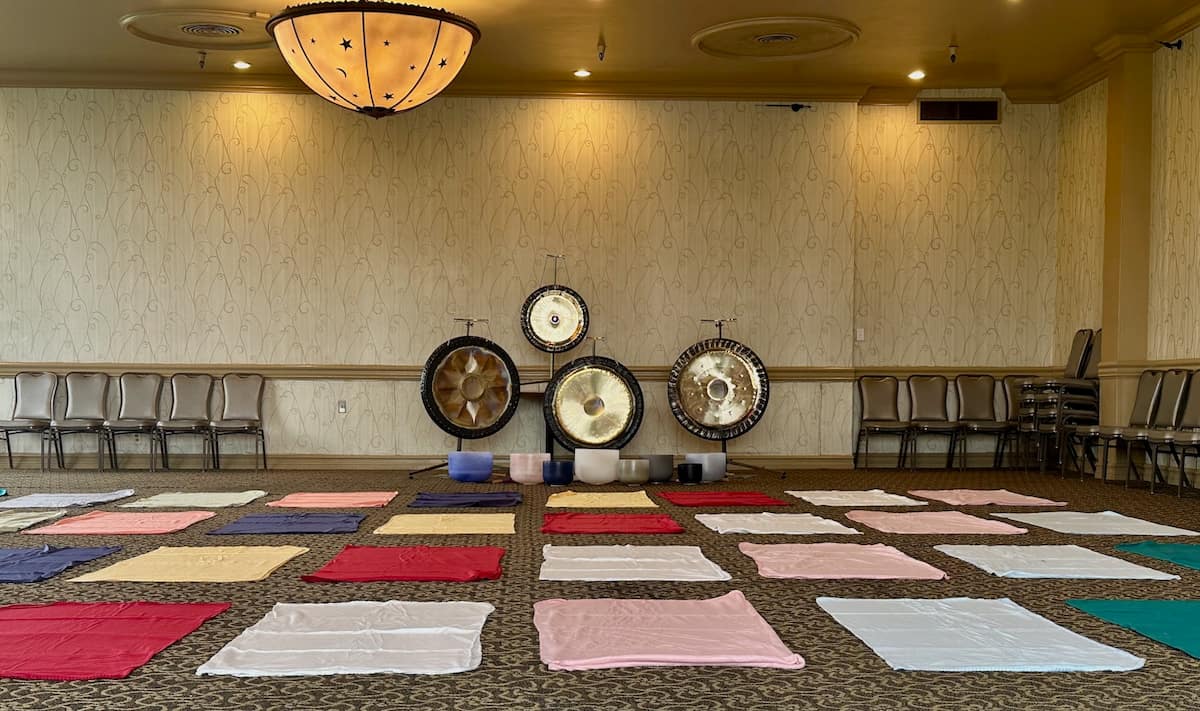
If you are looking into a corporate sound bath for your office, team offsite, or company wellness program, the most important thing to understand is this: not every sound bath delivers the same experience. Two events can both be called a “sound bath” and produce very different results for the people in the room. The difference usually comes down to one thing, whether the practitioner plays crystal singing bowls alone, gongs alone, or both, and whether they are trained to use them well.
At The Soundbath Center, we have led sound baths professionally since 2004, including more than 4,000 public events and a growing number of corporate bookings. We hear from a steady stream of businesses that want to add a sound bath to a team offsite, an employee wellness program, or a company retreat. Only some of those inquiries turn into bookings that are the right fit. This guide explains why, so you can make a more informed choice, whether you book with us or with someone else.
Why Most Sound Baths You Will Find Are Bowl-Only
Crystal singing bowls are the easiest sound bath instrument to find. They are relatively inexpensive, light enough to transport without much trouble, and visually appealing for marketing photos. Because of this, most practitioners working today play crystal bowls alone, or pair them with a single small gong used occasionally rather than throughout the entire sound bath.
Across twenty years of professional playing, we have observed that roughly half of practitioners who lead sound baths own at least one gong, and it is usually a small one, around 24 inches. Fewer than ten percent own more than one gong. Fewer still build their sound baths around gongs and crystal bowls together. This is not a criticism of bowl-focused practitioners. Crystal bowls are beautiful instruments that offer value. It does explain why a multi-gong, multi-bowl sound bath is much harder to find than a basic bowl sound bath, and why the two experiences are not interchangeable.
Takeaway: If your search turns up dozens of “sound bath” options in your area, most of them are working with crystal bowls alone. That is worth knowing before you compare prices.
What Gongs Do That Bowls Do Not
Crystal singing bowls produce a clear, sustained single note. That clarity is part of their appeal. It tends to keep listeners present, focused, calm, and aware of the room. A well-played crystal bowl sound bath typically keeps participants in what is sometimes called alpha, a relaxed but still aware brain state. People often describe these experiences as soothing, peaceful, and pleasant.
Gongs work differently. A quality gong of thirty inches or larger produces an exceptionally wide range of frequencies at once, far beyond what a bowl, or most instruments, can generate. That complexity gives the mind nothing simple to track or follow, so it tends to release its usual monitoring. This is part of how a well-played gong sound bath can move listeners through alpha and toward theta, the brainwave state associated with the hypnagogic threshold between waking and sleep. People who reach that deeper state more often report the kind of shift that stays with them after the event ends, something closer to a sense that real change took place, not just that they had a nice break.
Neither instrument is better in an absolute sense. A short, light moment of calm in a break room or between meetings may only call for crystal bowls. An event meant to give people real restorative depth, the kind that anchors a wellness program or a company retreat, generally calls for gongs.
Takeaway: Crystal bowls create presence and calm. Gongs create depth. Knowing which one you actually want is the first real decision in choosing a sound bath.
Why We Play Gongs and Crystal Bowls Together
At The Soundbath Center, every sound bath we lead combines gongs and crystal singing bowls rather than relying on one or the other. Bowls bring clarity and an easy way to ease people in and out of the experience. Gongs bring the depth and physical resonance that crystal bowls alone cannot reach. Played together, with the right technique, they create an experience with presence at the edges and real depth in the middle, rather than staying at the surface for the whole session.
How the instruments are played matters as much as which ones are used. We developed our signature method of playing specifically to keep the sound field continuous throughout the experience. Instead of one instrument stopping before the next begins, we layer the sound so that as one fades, another is already present. There are no gaps, and no silence woven in as a stylistic choice.
Takeaway: The instruments matter, but the technique connecting them is what actually determines whether a sound bath goes deep or simply sounds nice for an hour.
Why Staying in the Hypnagogic State Matters
When sound drops to silence during a session, even briefly, the nervous system notices. Silence, after a stretch of lying still with eyes closed, is a signal worth paying attention to, and the brain responds by shifting back toward alertness. The depth that took ten or fifteen minutes to build can dissipate within seconds.
This is the practical reason continuous, trained playing matters more than which instruments happen to be in the room. A practitioner who pauses between instruments, fumbles a transition, or runs out of material partway through is working against the very state the sound bath is meant to create. For a one-off personal session, that may not matter much. For a corporate wellness program or a team retreat your employees will compare to past experiences, it matters quite a bit.
Takeaway: A sound bath that keeps people at the surface is pleasant. A sound bath that holds them in a sustained, continuous state is the one people remember and talk about afterward.
Why Training Is the Real Differentiator
Anyone can buy a crystal singing bowl and call themselves a sound bath practitioner. Many people do. A quality gong played without skill makes noise. The same gong in skilled hands can change the entire atmosphere of a room.
A trained practitioner knows how to blend and transition between instruments without gaps, how to structure a session so it has a clear beginning, middle, and end rather than starting and stopping abruptly, and how to read a room and adjust to it. They also handle the parts of the work that have nothing to do with sound: arriving on time, communicating clearly about what to expect, setting up efficiently in a space they may be using for the first time, and conducting themselves professionally around your team.
None of that comes from owning instruments. It comes from real experience, built over years, leading real events for real groups.
Takeaway: When you compare options, ask less about what instruments someone owns and more about how long they have been playing and how many events they have actually led.
What to Ask Before You Book
A practitioner with real experience will answer these questions directly and specifically. A vague answer, or one that leans on spiritual language instead of practical detail, is worth treating as a signal.
- How many gongs do you use, and what size are they?
- How many crystal singing bowls are in a typical setup?
- How long have you been playing professionally, and how many group events have you led?
- What type of training do you have in playing sound baths and leading groups?
- Is the sound continuous throughout the session, or are there breaks between instruments?
- Have you led corporate events or company offsites before?
A Note on Scale: How Many Gongs and Bowls Do You Actually Need
For most settings, office wellness rooms, conference centers, and offsite retreat venues, two to three gongs paired with five crystal singing bowls is a strong, well-rounded setup. That combination gives a practitioner enough range to build real depth with the gongs and enough clarity with the bowls to shape the beginning and end of the session. This is the same range our own signature GongPlay® Soundbath is generally built around. For a shorter experience, or a small space one gong with five bowls can give a good experience.
Larger venues, bigger groups, or a flagship company event may call for more instruments to fill the space and hold the room, which is part of why we also offer a Presentation plus Gong Sound Bath option and a fully custom format for bigger or more involved events. The right scale depends on your venue size, your group size, and how central this experience is meant to be to your program. This is worth discussing directly with whoever you book, rather than assuming more instruments are automatically better. What matters most is that the instruments present are played well, not simply that there are many of them.
Takeaway: Two to three gongs and five crystal bowls cover most needs well. Scale up from there based on your space and your goals, not for its own sake.
What a Corporate Sound Bath Should Cost, and Why Quotes Vary So Widely
When you start comparing quotes, you will likely see a wide range. Some of that range is normal market pricing. A meaningful part of it comes down to what is actually being offered. The lowest quote you receive is very often a single practitioner with a small set of crystal bowls and no formal training, working with minimal overhead. That is a real, valid offering for some purposes. It is not the same service as a trained gong and bowl sound bath, even though both can be listed under the same name on a price sheet.
What a higher price reflects, when it is a real difference and not just markup, is training, instrument quality and count, and years of experience leading groups your size. None of that shows up on a price sheet. It shows up in the room. If price is the only thing you compare, you are likely comparing two different services as though they were the same one.
Takeaway: Before deciding based on price alone, ask what is actually included. A lower quote that turns out to be a single practitioner with three lower quality bowls and no training is not a discount. It is a different, lesser experience.
Get a Sound Bath That Works, Not Just One That Is Easy to Find
A basic crystal bowl sound bath is easy to find almost anywhere. If your goal is simply to check a box on a wellness program, that may be enough. If you want your company offsite or wellness program to offer something people genuinely remember and talk about, the bar is different. It calls for trained gong and bowl playing, sustained sound, and a practitioner with the experience to deliver it consistently, not just on a good day.
If what you want is light, ambient background sound, something quiet in a wellness room or a calm moment between meetings, we can provide that. It is not where our experience and training matters most, and you would be missing out on the deeper, more memorable experience that trained gong and bowl playing makes possible. For most of the businesses we work with, that fuller experience is worth the difference.
We have spent more than twenty years building toward that standard, through more than 4,000 public sound baths and a growing number of corporate bookings. If you are ready to book a corporate sound bath event for your office or team, visit our corporate sound bath page to see what is included and get in touch.
Learn About Our Corporate EventsRequest a Quote